


👋 Hey, it’s Stephane. I help engineers become great engineering managers - whether you want to become one or are already leading a team.
Paid subscribers get 50 Notion Templates, The EM’s Field Guide, and access to the complete archive.
A hiring manager friend of mine asked me a question this week that I haven’t been able to stop thinking about.
“What characteristics have been the strongest predictors of success in your best hires?”
As he was preparing this period for mid-year review discussions, he realised that one of his best performers didn’t do well during their interview. In fact, they absolutely bombed it. The kind of bombing where, if three other strong candidates had been in the pipeline that week, this person would never get an offer. They got hired on a coin-flip of a hiring committee, and then turned into the best hire they had ever made.
How is that even possible?
So, I decided to retrospect in my own hiring journey and reflect on what my great hires have had in common. Two things keep coming to mind:
Low ego, but confident - happy to flag a problem or push back, never defensive when challenged
Fast self-learners - they picked things up without hand-holding
The question I got is the whole issue. Because once you start pulling on it, you might find something uncomfortable.
The traits that predict your best hires are being punished?
Here’s the position I’ll defend for the rest of this issue: the traits that correlate with your best hires are, structurally, the traits a normal interview filters out.
A standard interview rewards the person who performs well under observation, with a stranger watching, on a clock. That is a real skill. It is also almost completely unrelated to the four traits that actually predict who thrives on your team a year later.
I went and pulled the research, then matched it against the patterns that hiring managers keep reporting. Four traits came up again and again. Each one predicts performance. Each one has a failure mode that makes it read as a weakness in an interview room.
Here are the four:
Low ego, but confident. Can read as “underwhelming”.
Fast self-learner, genuinely curious. Outperformed by pedigree and years of experience, which barely predict anything.
Clear communicator, even when blunt. Loses to candidates who are polished and charismatic but vague.
Owns their mistakes. Loses to candidates who spin, or who pick a safe, trivial “mistake” and never get challenged on it.
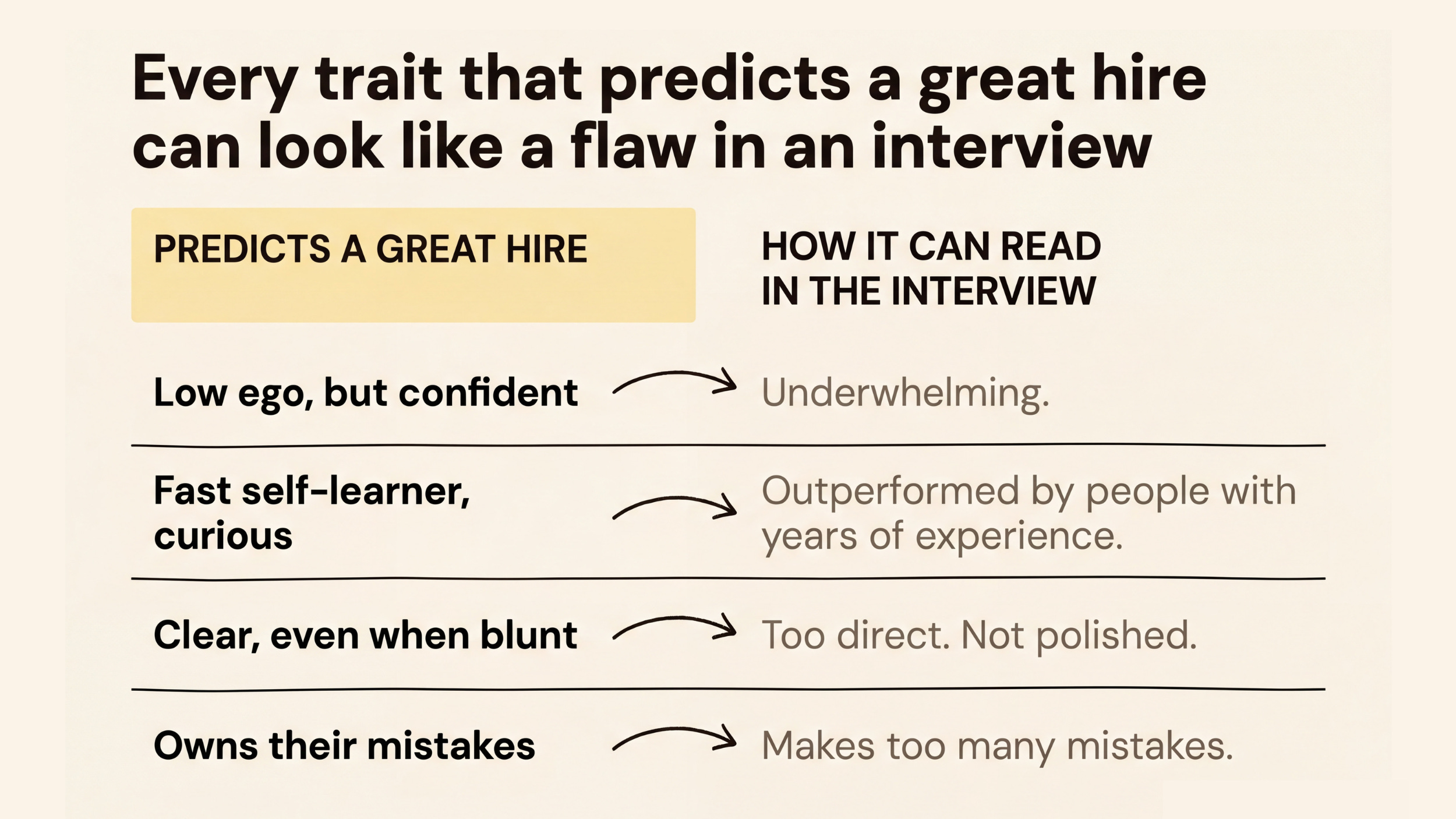
Look at that list and the problem jumps out. The thing that makes each trait valuable on the job is the same thing that makes it invisible, or even negative, in an interview.
The interview is measuring the wrong thing, and we have the data
Before I break down the four traits, I want to convince you that the interview itself is the unreliable instrument here. Because if you don’t believe that, none of the rest lands.
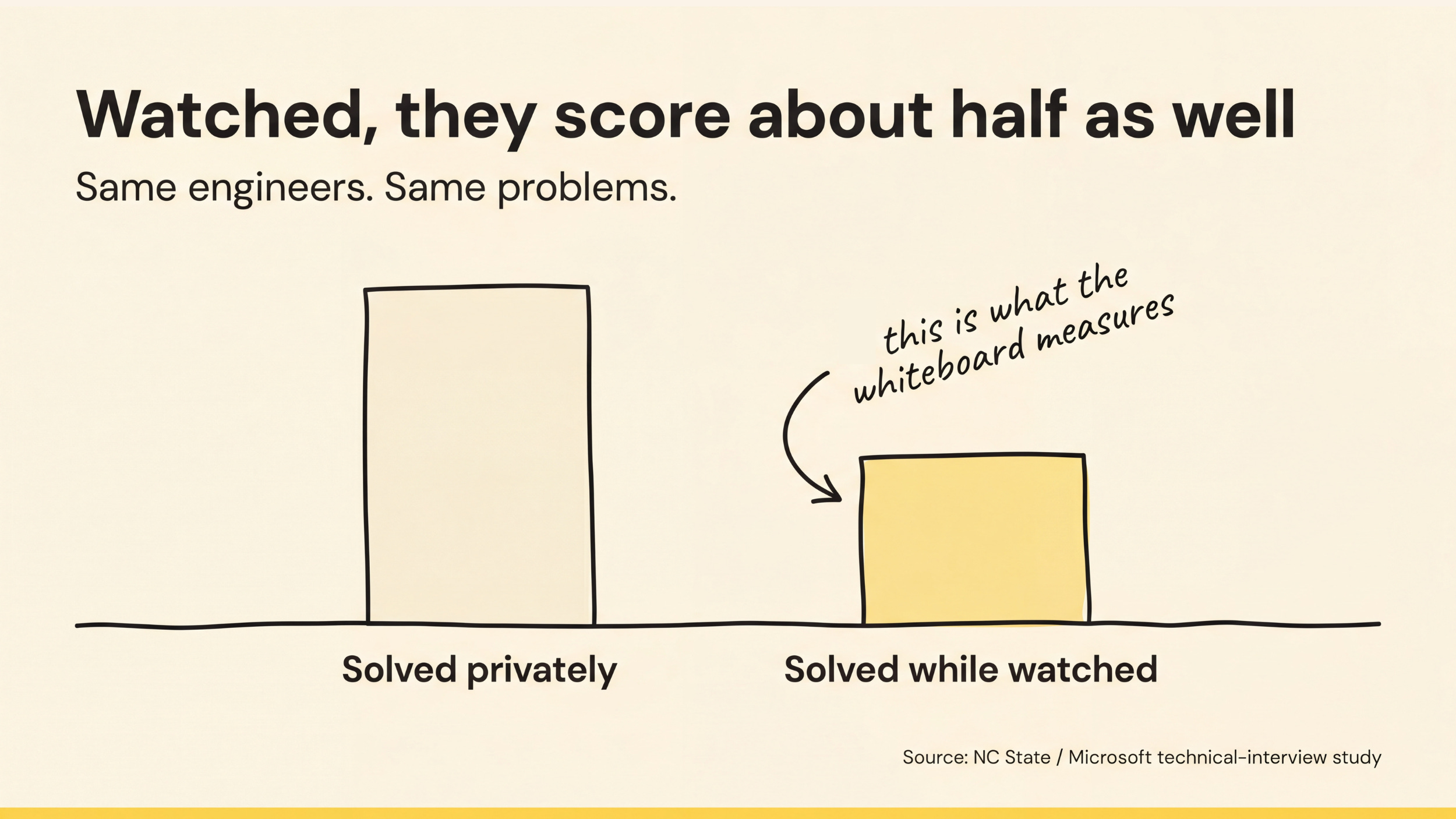
Start with the most damning study. Researchers at NC State and Microsoft ran a controlled experiment on technical interviews. Same problems, two conditions: some engineers solved them on a whiteboard with someone watching and talking, others solved them privately. The watched group scored roughly half as well. Same people, same difficulty. The whiteboard wasn’t measuring their engineering. It was measuring how they hold up with a stranger staring at them, which is a different trait, and not the one you’re hiring for. It also filters out capable introverts.
Then there’s the consistency problem. The team at interviewing.io ran thousands of standardized mock interviews and found the same engineer scores wildly differently from one interview to the next. If your signal swings that much on the same person, you’re not reading a property of the candidate. You’re reading noise.
And the self-assessment data is the part that stings. In that same interviewing.io research, impostor syndrome showed up about twice as often as overconfidence, and the people who underrated themselves were more likely to drop out of the process entirely. Read that again with trait number one in mind. The low-ego, confident engineer (the profile this whole issue is about) is statistically more likely to count themselves out before you even decide.
None of this is new to the people who study hiring. Laszlo Bock, who ran People Operations at Google, has said: “We found that brainteasers are a complete waste of time. How many golf balls can you fit into an airplane? How many gas stations in Manhattan? A complete waste of time. They don’t predict anything. They serve primarily to make the interviewer feel smart.”
I’ll grant the obvious counterpoint so you don’t have to email it to me: some environments genuinely do reward big egos. Fair. But “thrives in a political knife-fight” is a different hire than “makes your team better”, and most of us are hiring for the second one.
I’ve made the broader version of this argument before, in why your interview process for senior engineers is wrong and in stop interviewing engineers like it’s 2022. This issue is the practical version: the four traits, and how to actually screen for each.
Let me give you the first one in full, then the test that surfaces it.
Trait 1: Low ego, but confident
The trait. Not meek. Not arrogant. The specific combination of someone who will say “I think this design is wrong, and here’s why”, and in the next breath, “oh, you’re right, I hadn’t thought of that”. They hold a position and they update on evidence. Both.
Bradley Owens’ studies on what he calls “expressed humility” found that it predicted job performance above general mental ability and conscientiousness, and that it could even compensate for lower raw intelligence. A 2022 meta-analysis across more than 16,000 people tied humble leadership to higher task performance, more creativity, and more people speaking up. It named “intellectual humility” as one of the things Google actually hired for.
The failure mode in interviews. Candidates will undercount their own contribution, say “the team did it” when it was mostly them, and answer “I don’t know” without flinching. Next to a candidate who narrates every achievement in confident paragraphs, they read as junior, or unsure, or “not leadership material”. They might not be none of those things.
The test. Challenge a real decision they made. Pick something they described, push back on it, and watch which way they go. The arrogant candidate defends their ego. The meek candidate caves instantly. The hire you want does neither - they engage with the actual argument, concede the parts that are right, and hold the parts that aren’t. You’re not testing whether they’re correct. You’re testing what they do when someone smart disagrees with them, because that’s a thing they’ll do every week on your team.
Here’s the test for the other three, and how to assess each one:
