


👋 Hey, it’s Stephane. I help engineers become great engineering managers - whether you want to become one or are already leading a team.
Paid subscribers get 50 Notion Templates, The EM’s Field Guide, and access to the complete archive.
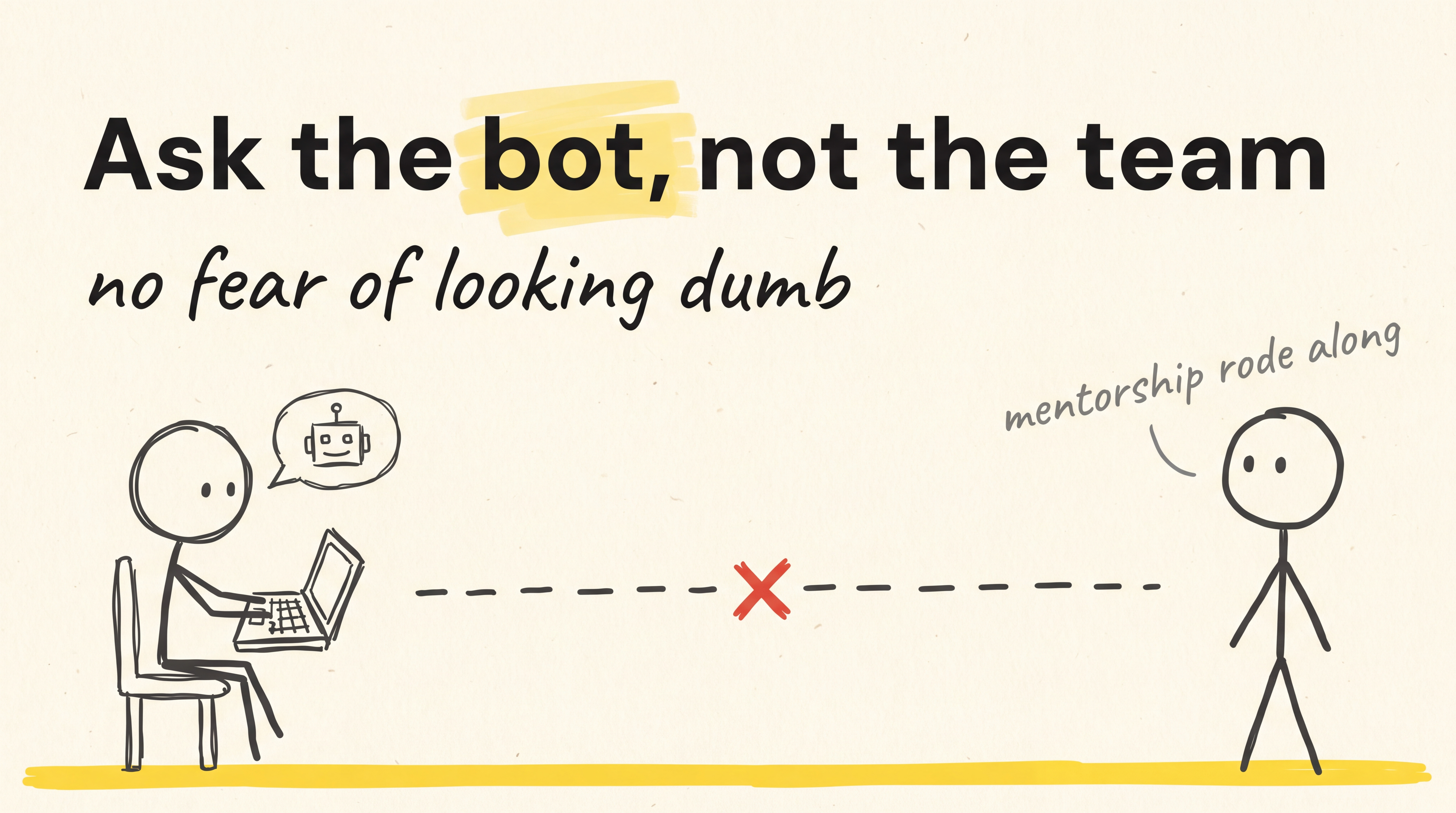
A few weeks ago I looked at my team’s slack channel and realized how quiet it had gotten.
Not quiet in a bad way. No one was stuck, no one was waiting for someone senior to free up to help them. The work was moving. But the steady trickle of “quick question, how do we…” messages that used to fill that channel had mostly dried up, and I knew exactly where it had gone. People were asking AI.
For most of my career, the reason someone interrupts you during the day is knowledge. They’re stuck, you’re the fastest path to unstuck, so they ping you. That interruption has a real cost. It breaks your flow, and it takes a long stretch to rebuild your mental context after you’ve been pulled out of it. We’ve always lived with that cost because the alternative was someone sitting blocked.
AI is changing that. A tool that explains an API, debugs a stack trace, or sketches an approach on demand is a new place to take the questions that used to go to a person. So they go there.
No wonder people asking AI than their teammates
I wrote before about how AI is breaking the way your team builds trust - senior engineers used to earn influence by being the person everyone came to, and that’s eroding. This is the wider version of the same story. The whole shape of how your team members talk to each other is changing.
A new study offers some numbers on it. In From Disruptions to Discussions (IEEE Transactions on Software Engineering, 2026), researchers from UBC and the University of Zurich ran a two-phase study: they followed 30 developers in their real work for up to twelve days, then surveyed 131 more.
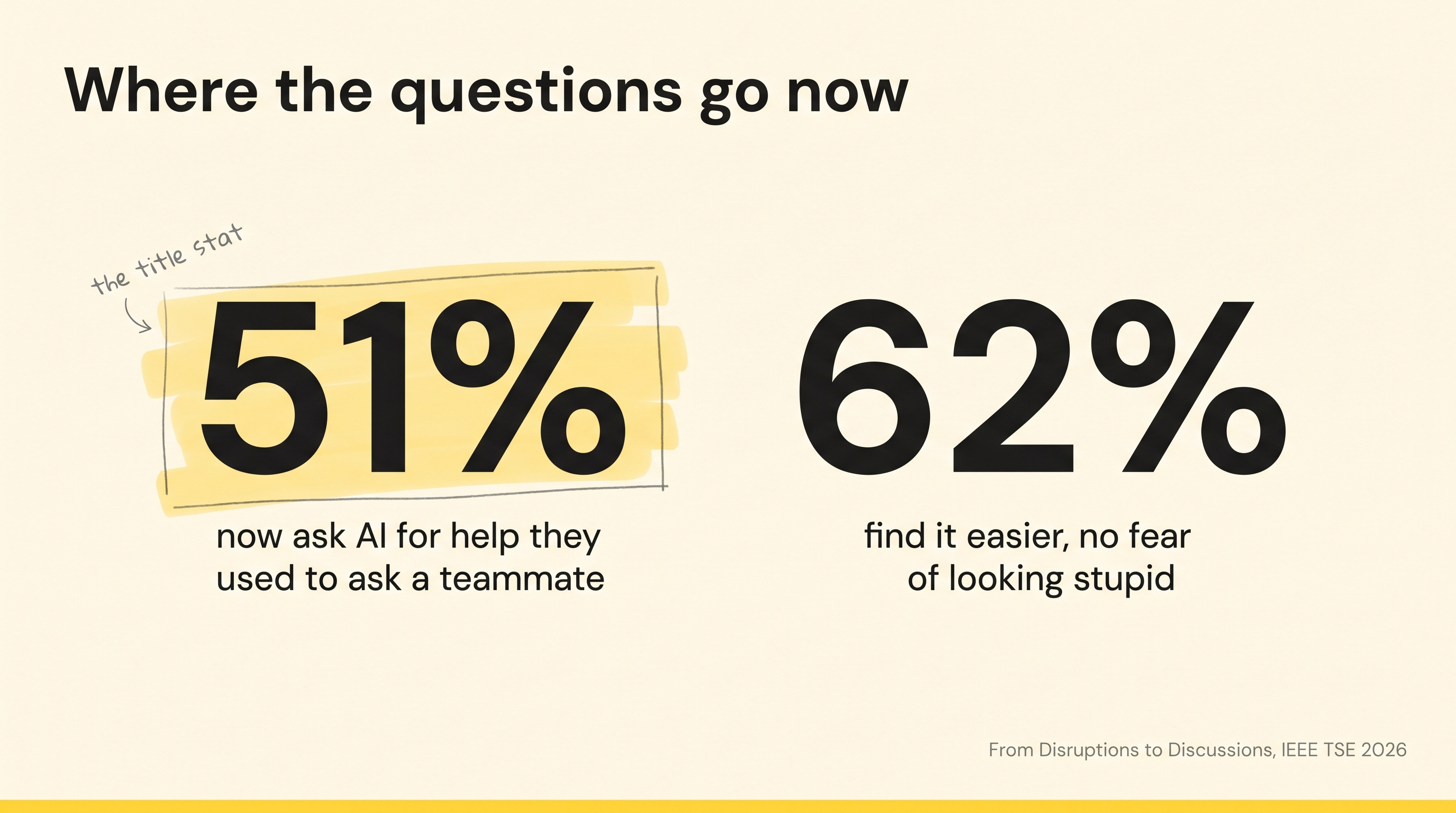
Half of those surveyed developers (51%) said they now ask AI for technical help they’d previously have asked a teammate for. More than six in ten said it was easier to ask the AI, because there’s no fear of looking stupid in front of a colleague.
Half the team rerouted their questions — and told researchers it’s because asking a machine beats the risk of looking stupid in front of you.
Amy Edmondson’s work on psychological safety showed that whether people feel safe to ask a question or admit they don’t know something is one of the strongest predictors of whether a team learns. AI is a judgment-free mentor. It never sighs, never makes you feel stupid, never remembers that you asked the same thing last week. No wonder people prefer it for the questions that carry a little shame.
A clean division of labor has appeared
The study found the conversations didn’t vanish. They changed purpose.
Developers took their technical and planning work to the AI: how to implement a feature, how to break down a task, brainstorm options. They kept going to humans for the things the AI can’t know: how the business logic works, what the requirements mean, how something was done here before and why.
So the human conversations that survive are the high-context ones. Clarifying a fuzzy requirement. Reasoning through a decision together. Weighing two approaches when there’s no clean answer. On paper, that’s a great trade. The routine stuff goes to the tool, and people spend their scarce attention on judgment.
The interruptions you’re glad to lose were doing invisible work
Every vendor selling you an AI tool frames the drop in “quick question” pings as a pure win. Fewer interruptions, more flow, faster shipping. The study saw some of that too, though it was uneven - only when AI was deeply embedded in the workflow did teams reliably report fewer interruptions.
But a “quick question” was never only an interruption. It was the delivery mechanism for things that don’t have their own meeting.
When a junior pinged a senior to ask why the retry logic was written that way, they got an answer - and they also got the reasoning, a war story about the outage that caused it, and thirty seconds of relationship. The senior got a signal about where the junior’s understanding had gaps. Both of them got a small reminder that the other person exists. None of that was on the calendar. Space was created for these things off the back of a routine question.
Take the routine question away and you remove the mentorship, the context transfer, the trust, the plain human contact.
You already watched this happen in public
If you want to know where this goes, look at Stack Overflow.
New question volume there is down roughly 76% since ChatGPT launched. (The decline actually started before ChatGPT, around 2021 - AI poured fuel on a fire that was already lit.) The routine programming question migrated from a public human forum to a private AI chat, at scale, in about two years. That migration is basically complete.
Stack Overflow got a public graph of its own collapse. The same migration inside your team leaves no chart at all.
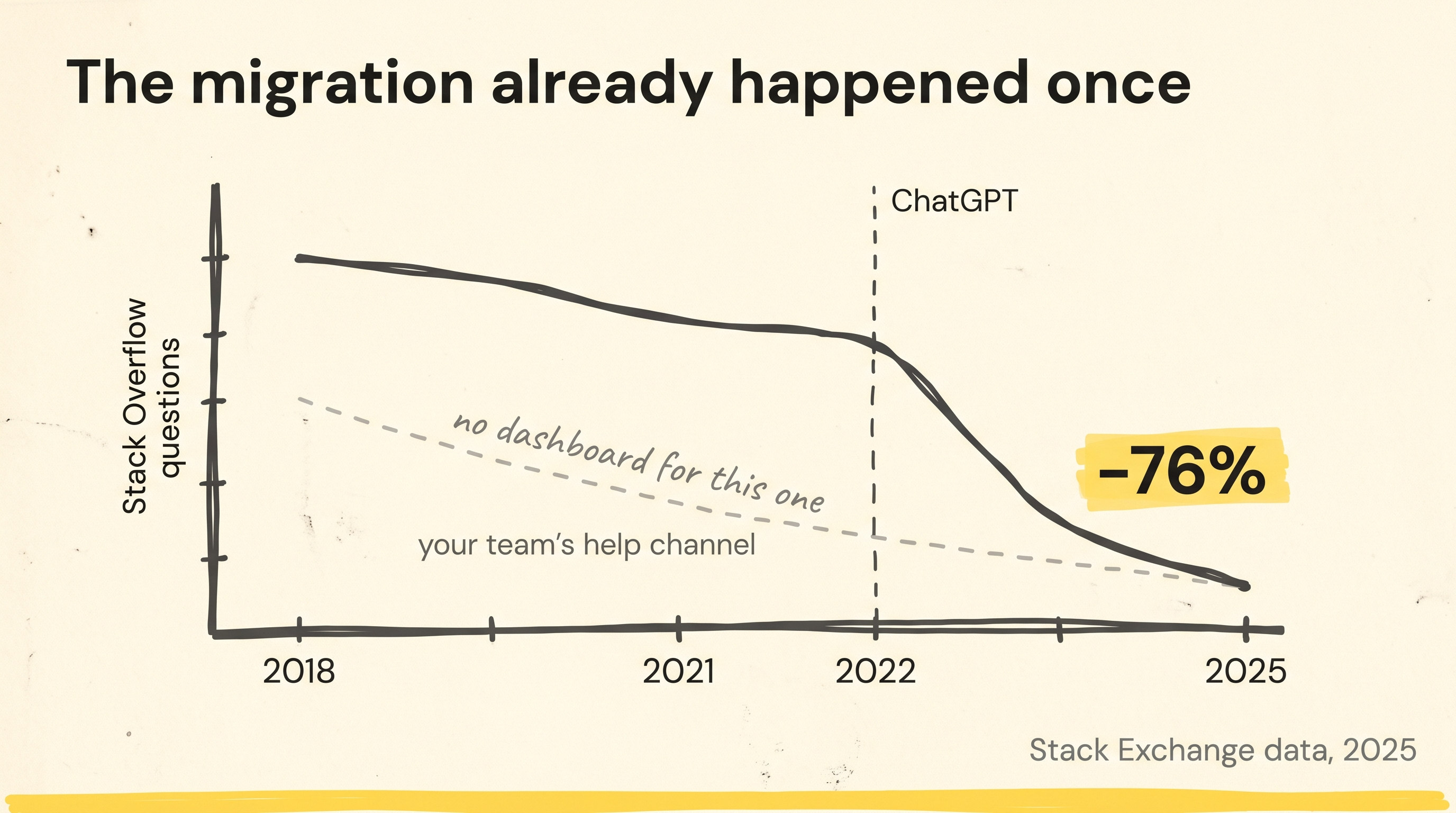
The same migration is happening inside your team right now, in your own team’s slack channel and your own DMs. The difference is that Stack Overflow could see it - they have dashboards, traffic graphs, a public number. You don’t. Your internal Q&A is having its own silent collapse and there is no chart that shows it to you.
The risk is that a load-bearing part of how your team learned and bonded is disappearing, and the disappearance is invisible by default.
The AI gives one answer. A team gives you several.
There’s one more thing the developers in the study kept wanting humans for.
The AI hands back a single, confident, consolidated answer. A colleague gives you a different answer than the colleague next to them, and the disagreement is the point. The friction between two senior engineers who see a problem differently is where the good decision usually comes from. A model that smooths everything into one tidy response removes that friction.
This is why none of this means “AI is making teams worse”. AI is an amplifier. It magnifies what’s already there - a team with strong habits around context, mentorship, and healthy disagreement gets sharper, a team that was already running on shallow understanding and isolated work gets more shallow and more isolated, faster.
Which one you get is not up to the tool. It’s up to you.
So the job changes. The routine Q&A is gone to the machine and it’s not coming back. What’s left for you to manage is the human layer the questions used to carry for free - and now you have to carry it on purpose.
Here’s how I’m doing that with my team, broken into the four steps:
