


👋 Hey, it’s Stephane. I help engineers become great engineering managers - whether you want to become one or are already leading a team.
Paid subscribers get The EM’s Field Guide, and access to the complete archive.
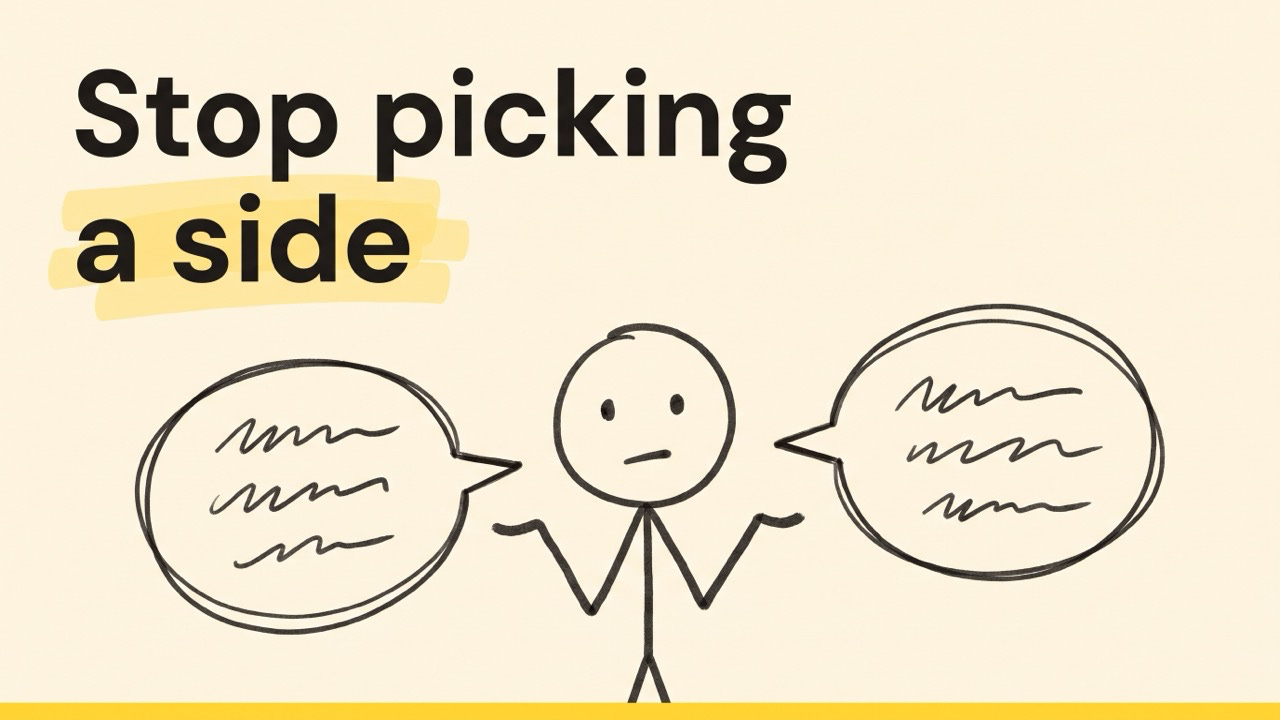
A manager I coach told me in our last call something I’ve now heard a few times in different forms.
There is an interpersonal conflict between two people in my team, but I hear completely different stories from each side. What should I do?
Doesn’t sound pretty, but at the same time, it’s completely normal.
You speak to one person and their version of what happened sounds completely reasonable. Then you speak to the other person and their version also sounds completely reasonable… but… they’re two very different stories.
The situation looked a bit like this:
One of them had been working on an architecture proposal for a change he wanted to propose for a feature his was working on. He presented it to the team and got some feedback from the other engineer. So, he made some changes, shared it again, and got more feedback. Repeated the cycle until he got some more feedback.
Eventually the other engineer basically took over the work and rewrote it herself.
When my friend spoke to the first engineer, he was really frustrated.
He felt like this kept happening. Every time he owned something, the other engineer would find something wrong with it, keep pushing for changes and eventually take over. She doesn’t trust me with anything and always finds things that I do wrong.
Then my friend spoke to the other engineer.
According to her, the design had some pretty important problems. She’d pointed them out, but the changes would never really address them. They went back and forth a few times and eventually she stepped in because they needed to move forward and she didn’t think what they were going for was good enough.
Her view was: I tried everything, what else was I supposed to do?
The problem is, that my friend was not around. He didn’t know exactly what was said or how it was said… So, what is he supposed to do?
Perspectives
Both people are probably telling you the truth. Not necessarily the truth, but their version of it, through their own lens, and following their own thoughts.
The first person sees a pattern of being constantly found wrong. The second sees a pattern of having to catch problems.
Both of those experiences can exist at the same time.
In order to progress with resolving the conflict, it’s important to understand that.
Don’t become the judge
Your first instinct might be to go find out who’s right and who’s wrong. Maybe there’s a performance concern, either with communication on how feedback is shared, or with technical/analytical skills on populating good architecture proposals.
Obviously you should understand what happened, but I wouldn’t approach it as an investigation into who is right.
I’d instead try to separate what actually happened from what each person thinks it means.
“He changed my architecture proposal.”
That’s something you can verify that actually happened.
“He changed my architecture proposal because he doesn’t trust me.”
That’s an interpretation.
“The architecture proposal needed changing because it wasn’t good enough.”
Also an interpretation.
That doesn’t mean those interpretations aren’t important btw. They are, and they tell you a lot about how each person is experiencing the relationship, but they’re different from the facts.
Look for the pattern
You want to find out what they disagree about, but more importantly you want to find out where they disagree.
Is it on PRs? When there’s an ambiguous big project that needs to get started? When someone is proposing an idea without offering useful context? When there’s delivery pressure?
You might start noticing that the same type of situation creates the conflict again and again.
I’ve written before about diagnosing difficult behaviour, code review friction and what happens when two senior engineers disagree on everything.
Sometimes something that looks very interpersonal is rooted in something completely different.
Maybe it’s unclear ownership, different expectations, no agreed way of making decisions, or a million other things.
Or maybe one person is just behaving badly in this situation.
What you do next so you can actually find out which one of all of those it is?
Here’s how I’d approach that situation and what I’d put in place afterwards:
👇👇👇 (access with a paid subscription)
