


👋 Hey, it’s Stephane. I help engineers become great engineering managers - whether you want to become one or are already leading a team.
Paid subscribers get The EM’s Field Guide, and access to the complete archive.
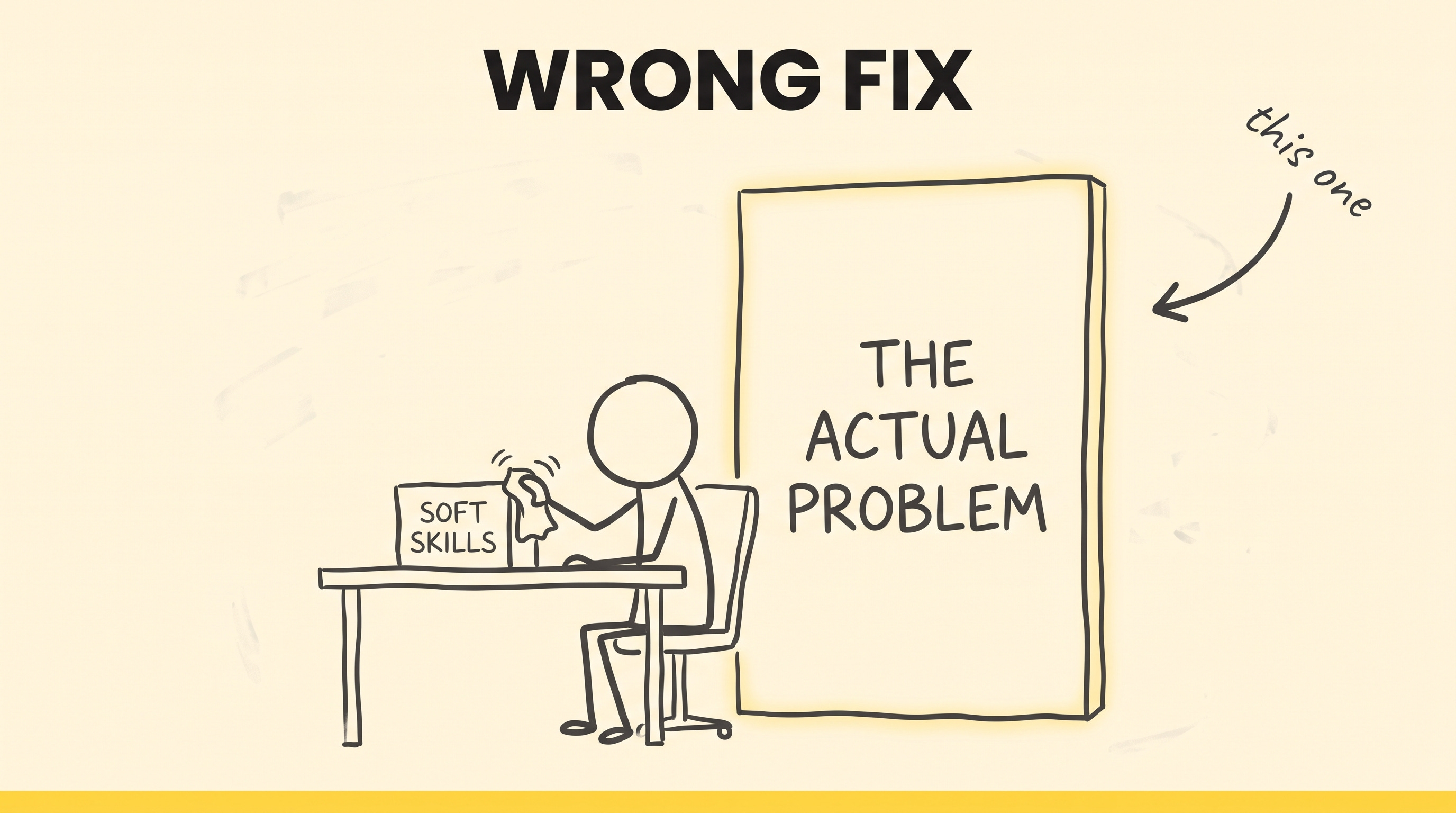
A senior engineer I coach told me recently:
“I know what I need to do. I’m technically strong. I just need to improve my soft skills.”
He genuinely believed he’d figured it out.
He’s been an engineer for around eight years. People trust him. When there’s a difficult problem, he’s usually the one everyone goes to. Yet he’d been saying this exact thing to himself for the past couple of years while watching people he considered less capable get promoted ahead of him.
The thing is, this isn’t unusual.
I’ve heard variations of this from so many senior engineers. It sounds like someone who’s correctly diagnosed the problem and just needs to put in the work.
The problem is... they’ve diagnosed the wrong thing.
That’s not to say soft skills don’t matter. They absolutely do.
But that sentence contains two assumptions that can send people in the wrong direction. They spend years trying to fix one area while the real reason they’re not progressing never changes.
I want to unpack both of those assumptions, because I think you’ll recognise someone in this story.
Maybe it’s someone on your team. Or maybe it’s you.
The first mistake: comparing yourself to a version of reality that doesn’t exist
Before we even get to “soft skills”, let’s talk about the feeling underneath that sentence.
The feeling of being behind.
An engineer gets to their early thirties. They’ve been doing this for seven or eight years. They’re good at what they do. But then someone younger than them becomes Staff. Someone on LinkedIn announces they’re now a Director. Recruiters that used to reach out for more senior roles now stop even replying.
Slowly, they convince themselves they’re behind.
Behind who?
That’s the question I always ask.
Most of the time, the answer is someone they’ve never actually worked with. Someone whose career they’ve pieced together from LinkedIn posts, job titles and a few assumptions.
The reality is much simpler.
There isn’t some universal career timeline you’re supposed to be following.
In fact, fewer than one in ten engineers ever become Staff. That’s not because everyone else failed. It’s because that’s how engineering organisations are designed. The higher you go, the fewer positions there are. Most engineers finish their careers as Senior Engineers, and that’s completely normal. I wrote about this in a previous article: senior is the destination for most engineers, not a stepping stone everyone is expected to move past.
So when someone tells me they feel behind, I don’t try to reassure them. Instead, I ask them who they’re comparing themselves to. Because almost every time, it’s comparison that’s creating the feeling, not reality. Take away the comparison, and suddenly there isn’t anything to be behind on.
That’s the first mistake.
The second one is much more interesting. And I think it’s the one that actually keeps people stuck.
The second mistake: you’ve defined “technical” too narrowly
“I’m technically strong. I just need to improve my soft skills.”
There’s a hidden assumption in there.
It assumes your technical development is finished. That you’ve reached the point where there’s nothing left to improve technically, and now the only thing standing between you and the next promotion is communication, influencing and stakeholder management.
I don’t think that’s true at all.
Technical skills don’t stop mattering once you become a Senior Engineer.
The skills that get you from junior to senior are things like writing clean code, designing systems and solving difficult technical problems. The skills that get you from senior to staff are different.
Now you’re deciding which problems are worth solving. You’re making architectural trade-offs. You’re spotting complexity before it gets built. You’re thinking about the long-term health of systems instead of just the feature in front of you.
It’s still technical. It just doesn’t involve writing as much code.
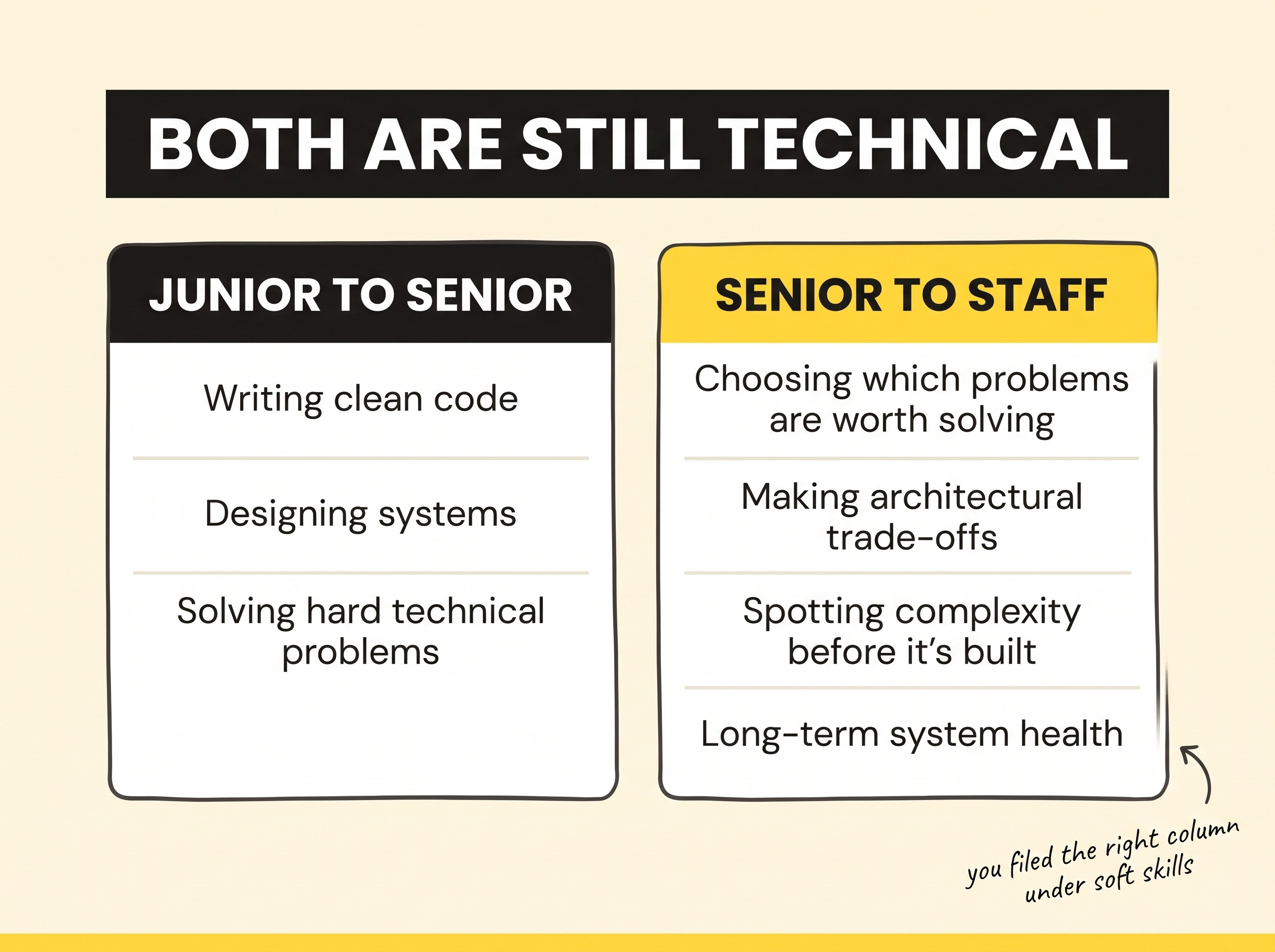
That’s why I always find it interesting when someone tells me they’re “already good technically”. Good at what? Good at the skills that got you to Senior? Probably.
But are you developing the technical skills that Staff Engineers are expected to have? Those are different skills entirely. I think this is where a lot of engineers accidentally get stuck. They take a technical problem, label it as a soft skills problem, and then spend years trying to solve it from the wrong angle.
What I see as a manager
As a manager, I can often tell that someone isn’t going to get promoted months before they realise it themselves. And it’s almost never because of their technical ability.
The problem usually shows up somewhere much smaller. It can be a meeting, a design review, or a discussion about priorities.
The engineer leaves thinking it went well because they made good points, were technically right, but they miss something important. Being right isn’t the same as getting people to follow you. And promotion committees care far more about the second one.
One of the things I hear all the time is:
“I’m just not naturally good with people.”
Or:
“I’ve never been good at reading the room.”
I don’t buy that. Reading the room isn’t something you’re born with. It’s a skill.
Like any other skill, you can break it down, practise it, get feedback on it and improve it over time. The problem is that most engineers never treat it like a skill. They treat it like a personality trait.
So instead of asking:
“How do I get better at soft skills?”
Ask something much more useful.
Where, specifically, do I keep falling short?
Because once you can answer that, you have something you can actually improve.
Below are three places I see engineers get stuck over and over again, and how to work out which one applies to you:
