


👋 Hey, it’s Stephane. Welcome to my weekly newsletter where I share lessons, and stories from my journey to help you lead with confidence as an Engineering Manager.
When I got my first Engineering Manager role, I was over the moon! I’d been coding for years, led a few projects, and had plenty of informal chats with teammates about career progression. How hard could managing people be, right?
Turns out, very.
Looking back I didn’t know much about management really.
When do I need to coach? When to mentor? I didn’t even know the difference between the two…
Many EMs, even experienced ones, still confuse these terms.
So, let’s untangle them once and for all.

Get hired as an Engineering Manager (sponsored)
If you are searching for an Engineering Manager job in this horrendous job market and want to make your life easier, I’ve got something for you!
I have created material that simplifies everything:
CV & LinkedIn for Engineering Managers
How to apply (and actually get interviews)
How to prep for behavioural/leadership/people & values interviews
Many people have used the exact same resources in the past year and saw immediate success!
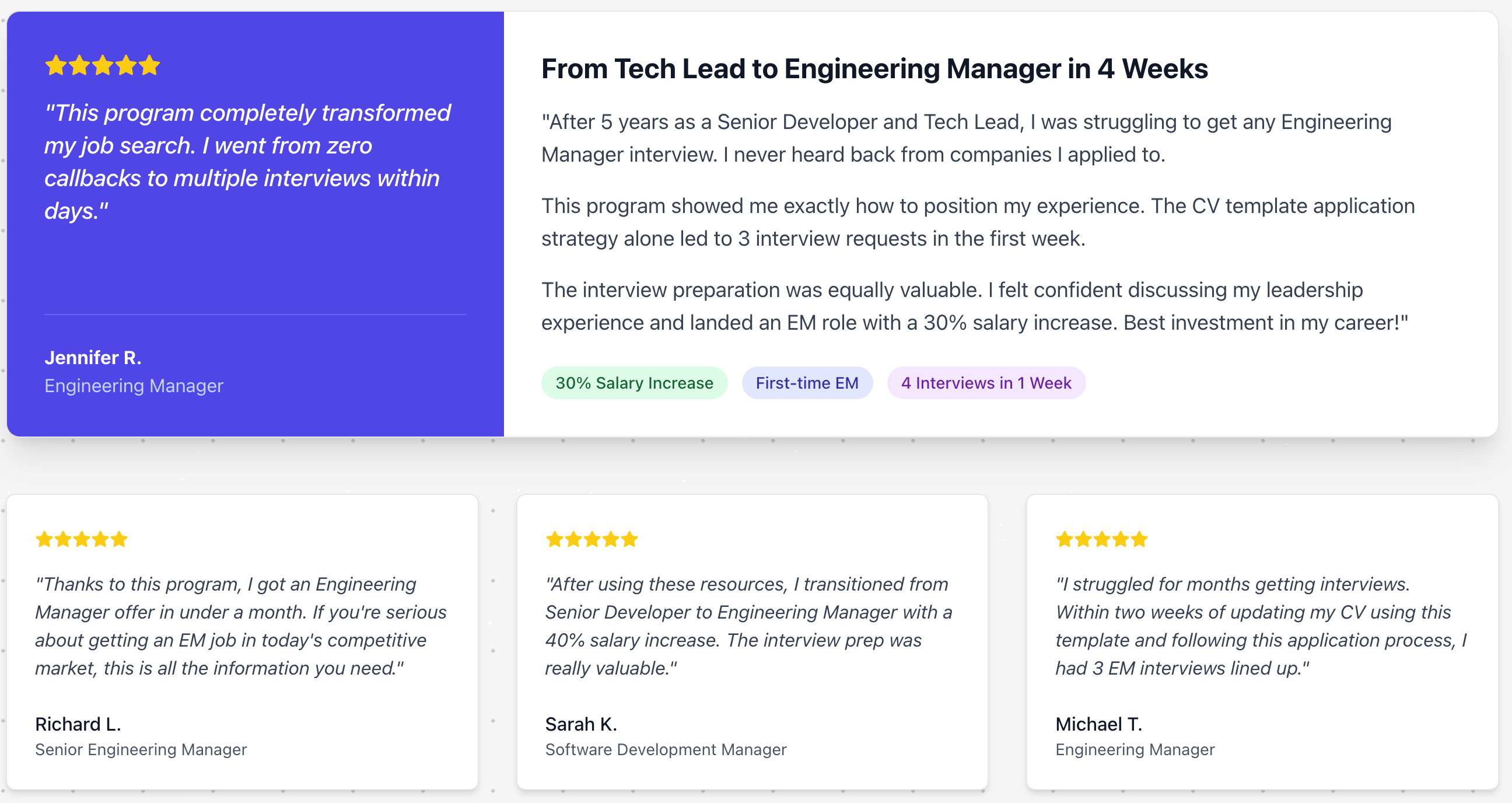
I created this system for myself first, and since I have found so much value from it, I needed to share it with you too!
If you have any questions on it, feel free to reach out at stephane@em-tools.io
Back to this week’s thought.
Coaching
Imagine your developer Sarah struggles with task prioritisation. As a coach, your role isn’t to swoop in with your "perfect" solution. Instead, you want to guide Sarah to uncover the answers herself by asking questions. For example:
What’s your goal here?
What's worked for you in the past?
What’s getting in your way right now?
Coaching is not providing solutions. It's nurturing problem-solving skills with the goal to empower your engineers to rely less on you and more on their own capabilities.
This applies to all contexts by the way. I am pretty sure that a great coach can help a person on any field find the answers that they need just by asking the right questions.
An easy way to practice coaching: in your next 1:1, pick one topic your engineer struggles with and only respond with open-ended questions. Resist the urge to provide immediate solutions.
Mentoring
Mentoring, on the other hand, is where your past experience must come into play. Your junior developer, Alex, might be navigating a tricky promotion path, and your own lessons and expertise become very useful.
Mentoring is stepping in as someone who's "been there, done that" offering your experiences to shape Alex's path:
When I was in your shoes, here’s what worked for me...
I faced a similar challenge, and here's how it played out...
Mentoring is deeply personal and anecdotal. It relies heavily on your experience to guide and inspire.
If you would like to practice mentoring share short, relevant personal stories.
Note: Both coaching and mentoring can be applied at a 1:1 level but also with the whole team. It’s on you to assess what individuals or your team needs more from you.
Get 50 Notion templates & The EM’s Field Guide when you subscribe
Managing
This one is straightforward but often misunderstood. As a manager, your job is setting clear expectations, tracking progress, and holding your team accountable.
Unlike coaching (question-driven) and mentoring (experience-driven), managing focuses on outcomes and alignment:
Clearly define what success looks like.
Regularly review progress against goals.
Hold structured conversations about performance.
Management is less about how your engineers feel and more about what they achieve.
You need to do all of them
When I first mixed these up, I accidentally mentored when I should've coached and managed when I should've mentored..
My team became overly dependent on my direct input.
I unintentionally blocked creativity and independence.
Accountability got blurry because I wasn't clear enough on expectations.
If your engineers don't know whether you're advising, guiding, or holding them accountable, expect frustration and subpar results.
To be a great leader and manager you need to coach as well as mentor as well as manage your team and team members.
An example
Let’s say your engineer, Jake, keeps missing deadlines.
Coaching: You’d ask Jake questions like: "What’s holding you back?" or "How can we better manage your workload?"
Mentoring: You’d share, "When I faced similar deadline pressures, I learned to set daily mini-goals, could this help you?"
Managing: You clearly communicate, "Jake, deadlines must be met. Let’s set up checkpoints to ensure you stay on track."
Each approach has its place, but knowing when to use each is important and you have to remain flexible on when to use each one.
Reference guide
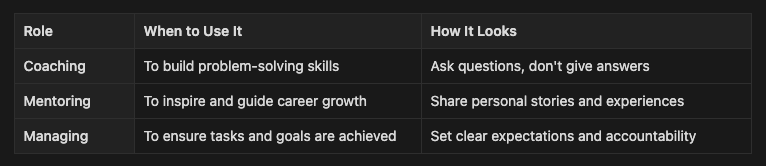
So, how do you balance all three?
Awareness and intentionality.
Before every 1:1 or team meeting, clarify your objective. Are you there to coach, mentor, or manage?
If you’re feeling particularly open and transparent (which I recommend) you can even let your engineers know explicitly what you're doing, like, "Today, I’ll put on my coaching hat" or, "I’d like to mentor you through this scenario".
This will bring your colleagues clarity and yourself the confidence you need.
Bottom line
Mixing coaching, mentoring, and managing is not a trivial mistake, it can actively hurt your team's growth and performance. But now, you're equipped to fix it.
Pause before every interaction. Decide clearly what your engineer needs. And then deliver exactly that.
You’ve got this.
That’s all, folks!
See you in the next one,
~ Stephane
PS. If you’re taking this management thing seriously, here are more ways I can help:
Follow me on LinkedIn for insights during the week.
As mentioned in this article, if you’re looking for an Engineering Manager job, check out this product that I made for you to 3x your interviews!
Check the products that I offer with a paid subscription - 50 Notion templates, guides, and more. It’s a lot!
Work with me through 1:1 coaching. I find it extremely rewarding to give personalized guidance to engineering leaders who are interviewing for EM roles or are looking to grow in this area.
If you’re a Software Engineer I have a partnership with CodeCrafters – build Redis, Git & more from scratch (40% off with my link).
If you're preparing for interviews, I am also writing this newsletter for architecture design that you might be interested in:

A clear guide on on the differences between coaching, mentorship and management. Thank you Stephane!
Great topic! Rarely broken down this well.