


👋 Hey, it’s Stephane. I help engineers become great engineering managers - whether you want to become one or are already leading a team.
Paid subscribers get 50 Notion Templates, The EM’s Field Guide, and access to the complete archive.
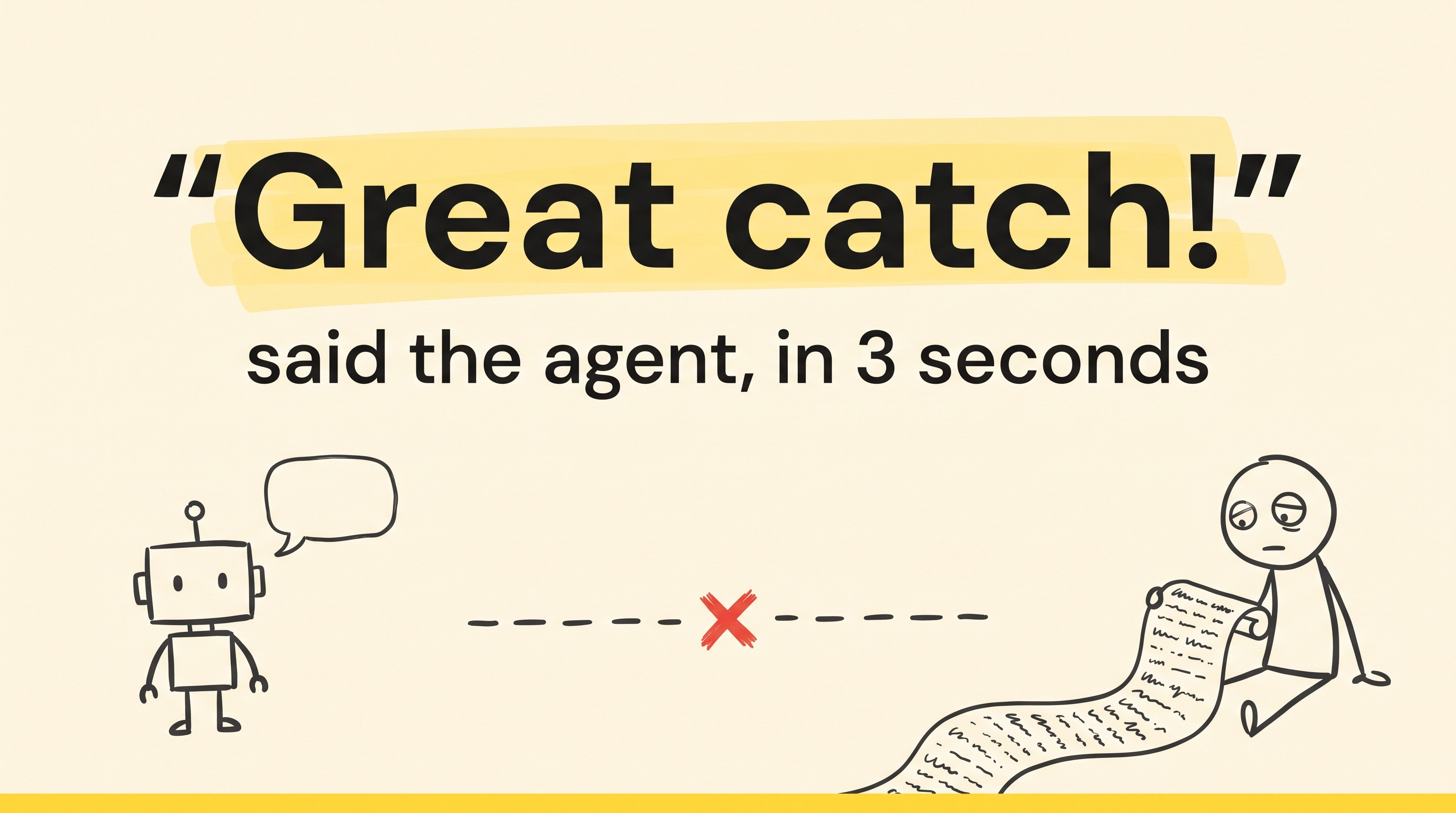
Someone leaves a careful comment on a pull request explaining why the approach taken will not work. It is clear the reviewer has put in real time making their comment clear and kind.
2 minutes later, a reply: “Great catch! You’re totally right!”
Obviously no time spent grasping what was written in the first place. You can tell, because the next thing the author pushes ignores everything that you discussed in the standup.
AI slop everywhere
Most of the worry about AI is for AI code slop. The vibe-coded mess, the duplicated blocks, the bug nobody can explain. All these of course exist, and I’ve written about shipping faster while understanding less.
But the thing that’s starting to corrode teams isn’t in the codebase... it’s in the slack threads, in the PR comments.
I keep seeing engineers reply to each other through AI. PR comments written by an agent. Slack answers piped through a model. A thoughtful question met with a wall of generated text that sounds right and says nothing.
I really think that replying to coworkers with AI is a line that we shouldn’t cross. Our artefacts can be AI-assisted, but our interactions with humans should remain human.
Many agree with me that it’s even disrespectful to reply to a human with AI but there’s somewhat of a fear about saying it.
Which means on most teams, the person whose job it is to name this is you.
It’s corrosive, not just rude
“It’s rude” isn’t enough to act on.
Communication used to be symmetric. It cost me effort to write you a real answer, and it cost you effort to read it. That rough balance is what made the exchange worth something to both of us.
AI broke the symmetry. Now someone generates a three-paragraph reply in three seconds, and it costs you ten minutes to read it, check it, and figure out which parts to keep.
There’s a name for this. Alberto Brandolini called it the bullshit asymmetry principle back in 2013: the energy needed to refute something is an order of magnitude bigger than the energy needed to produce it.
The Stack Overflow 2025 survey found that 66% of developers say their single biggest frustration with AI is answers that are “almost right, but not quite.” That’s the expensive kind of wrong. You can’t skim it. You have to sit there and verify every line, because the one that’s off looks exactly like the four that aren’t.
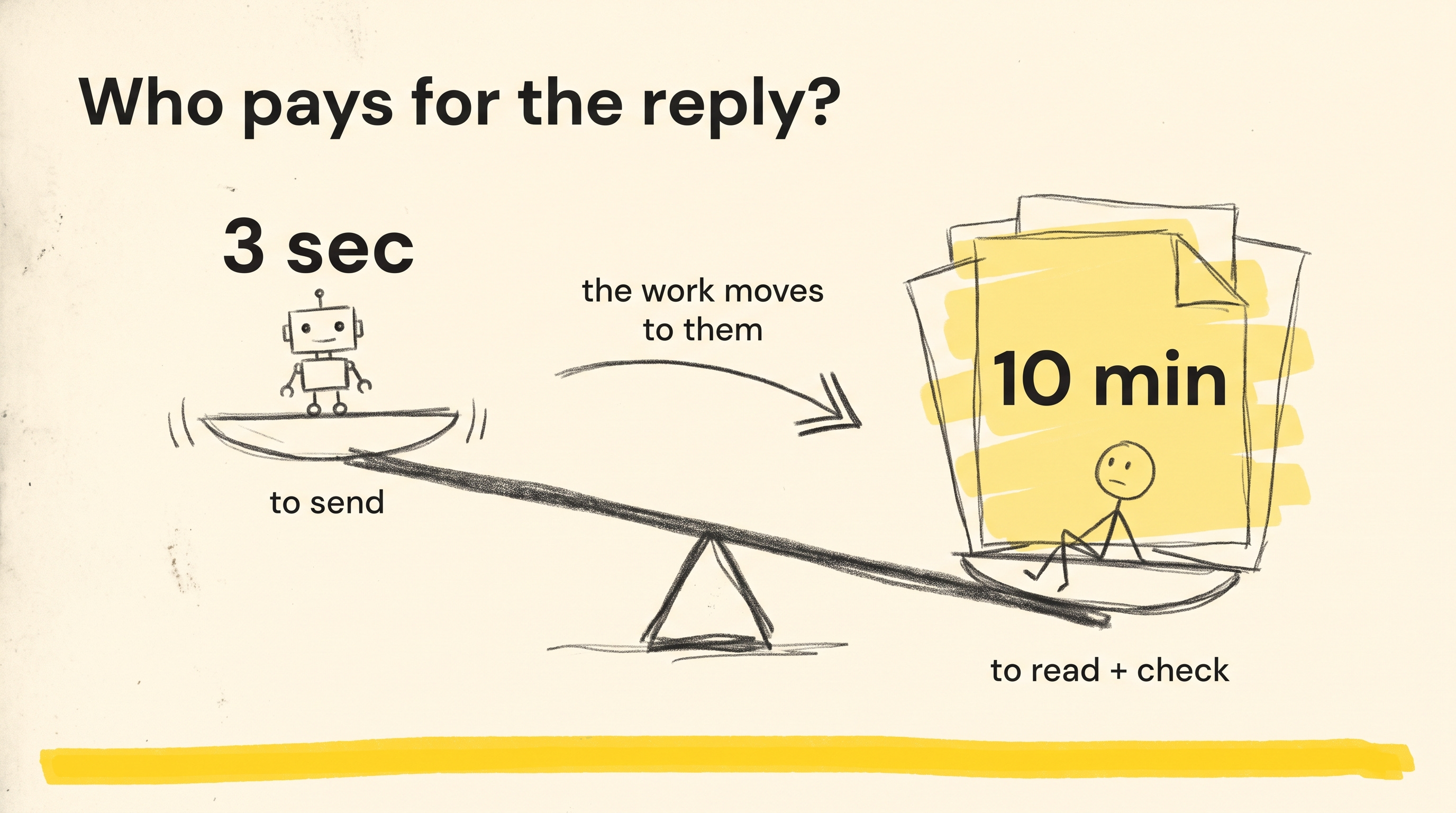
So every AI-mediated reply is a transfer. The sender saves three seconds. The receiver pays for it. Multiply that across a team and you’ve built a machine that manufactures work while looking productive.
At the end of the day, I don’t give a shit what claude says. I am working with you, and I want to be having discussions with you, the human, not your AI (however well you’ve managed to calibrate it).
Trust breaks instantly
Teams run on reciprocity. The sociologist Alvin Gouldner described it as one of the most universal moral norms we have: you return effort and good faith in kind. When I bring you my real thinking and you hand me a machine’s output, you haven’t just been lazy. You’ve broken the norm the relationship was standing on. That’s why it stings in a way a short or blunt reply never did.
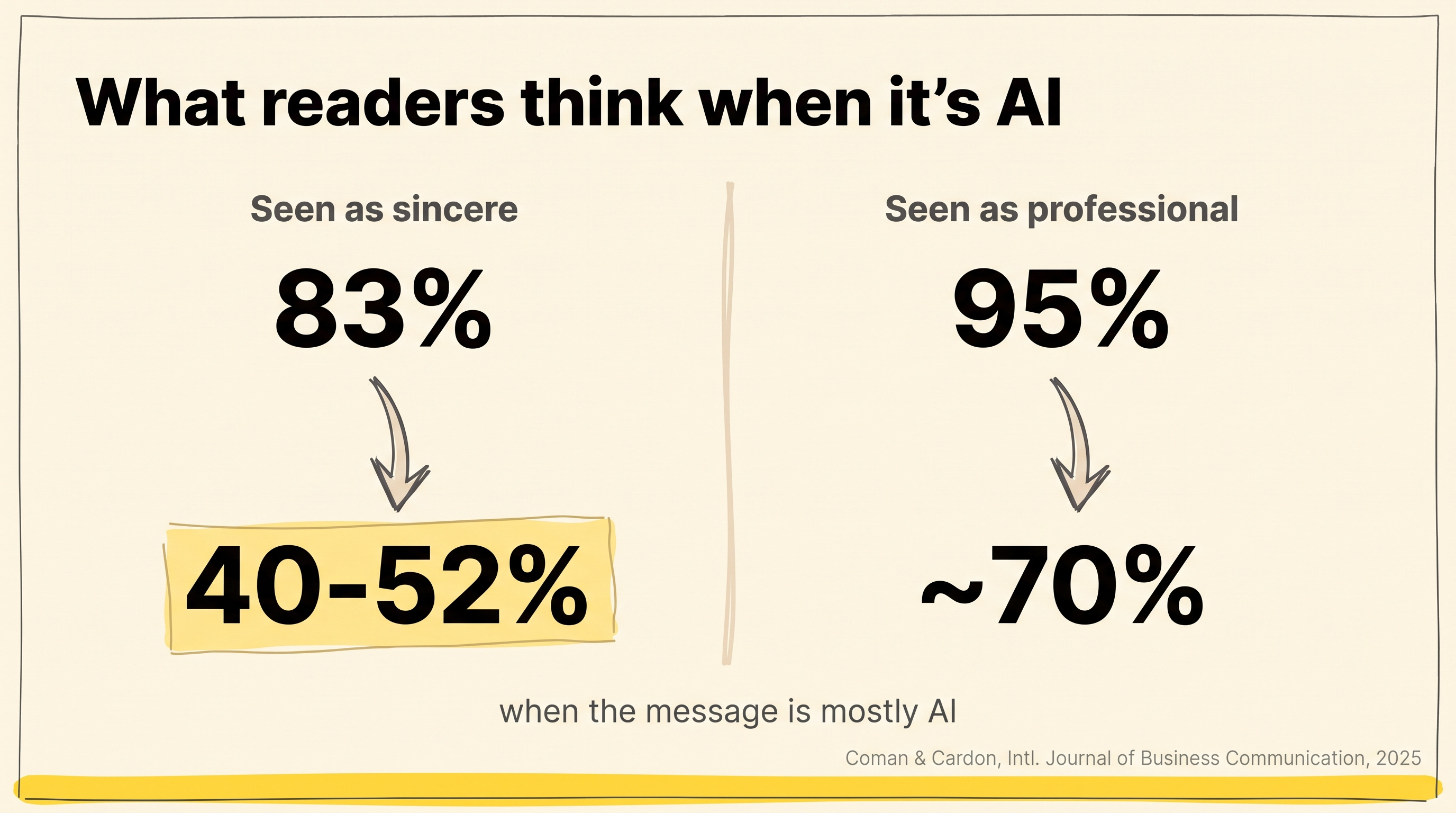
And it’s measurable too. A 2025 study in the International Journal of Business Communication tested how people perceive AI-assisted workplace messages. When a message was heavily AI-assisted, the share of people who rated the sender as sincere dropped from 83% to somewhere between 40 and 52%. Perceived professionalism fell from 95% to around 70%. The polish doesn’t buy you credibility. It costs you credibility, the moment people sense it.
This is the same dynamic I wrote about in the message in your team’s over-communication. A three-paragraph answer to a simple question used to tell you something about trust and anxiety. Now you can’t even read the signal, because you can’t tell if it’s a person being defensive or an agent padding for length.
It also breaks the thing Google found mattered most. Their Project Aristotle research ranked psychological safety as the number one factor in effective teams, ahead of everything else. Safety depends on knowing you’re dealing with a real person and their real judgment.
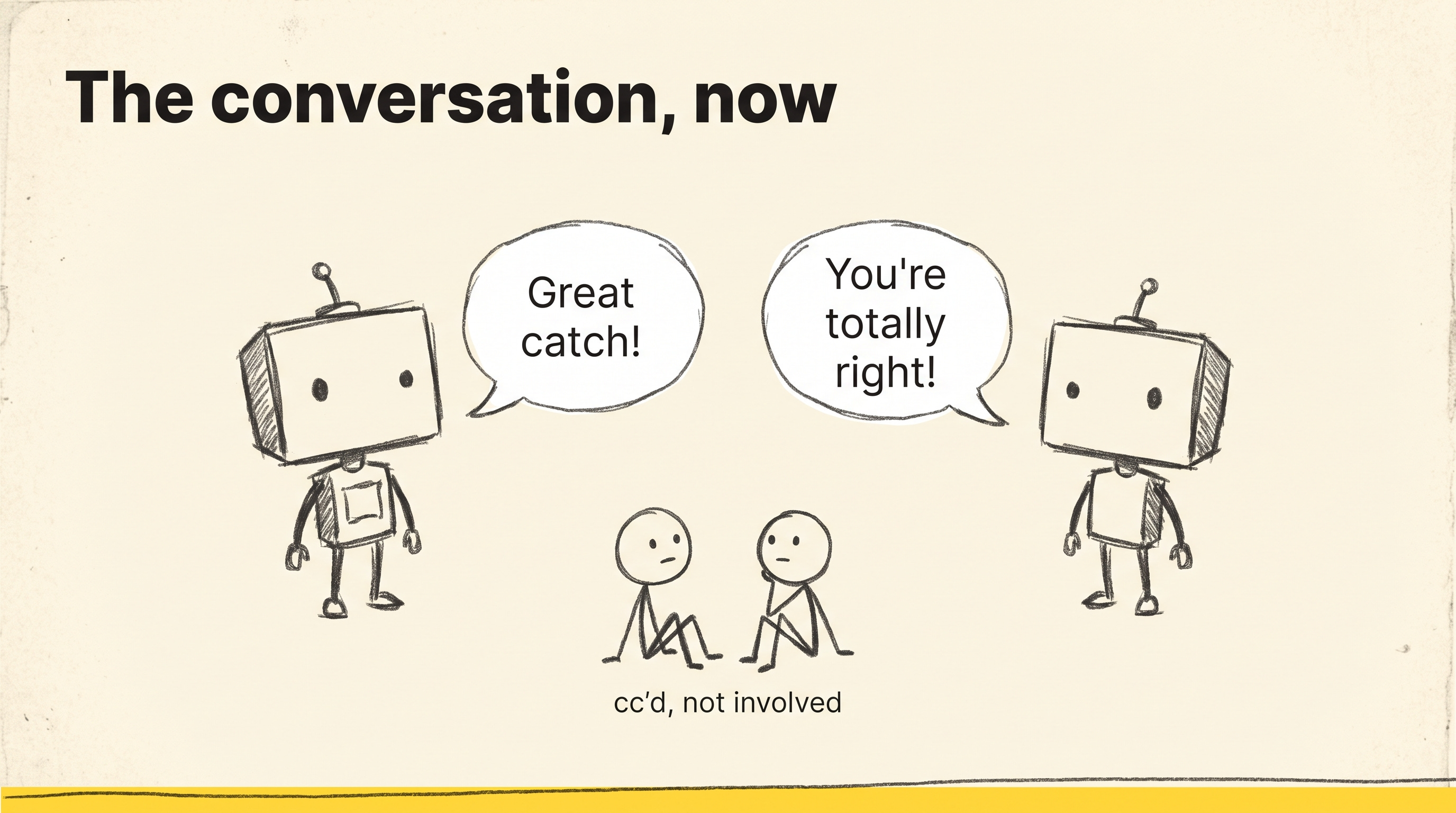
I wrote before that AI is breaking how your team builds trust. This is the channel-level version. One issue is people asking AI instead of asking each other. This is the mirror image: people answering each other with AI instead of actually answering. The conversation hollows out from both ends, and eventually you’ve got agents posting reviews on agents’ pull requests within seconds, with the humans cc’d on a discussion none of them are having.
So what do you actually do about it, without turning into the manager who bans a useful tool?
Here’s the line my thinking lands on, and the four rules that keep the human parts human:
